
Whose Holiday Are We Celebrating, Exactly?
Multicultural, multi-ethnic holidays under one roof: clashing traditions, family guilt and how women living across borders design celebrations that feel true.
12/6/20254 min read
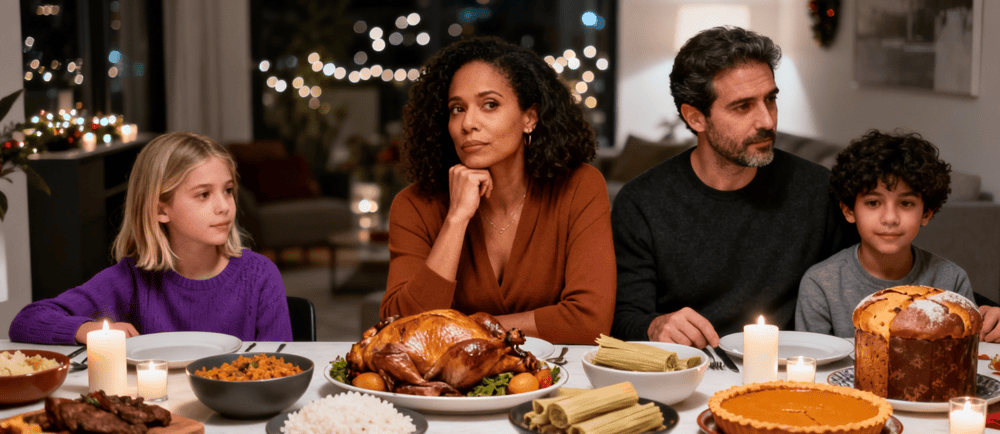
There is a special kind of chaos that happens in multicultural homes around the holidays.
The calendar flips to November or December and suddenly the questions begin:
Do we do your holiday or mine?
Are we flying “home” or staying “home”?
Are we doing turkey or tamales? Panettone or pecan pie?
Do we open gifts on the 24th or the 25th?
Which grandmother will be offended this year?
In a global, mixed-culture, blended-everything life, holidays are not just dates. They are negotiations. They are quiet power struggles. They are love notes to the cultures you refuse to let disappear and a test of how much your nervous system can handle in one season.
No one puts this in the expat brochure.
The invisible politics of tradition
Every tradition carries subtext.
If you grew up in a culture where holidays were loud, crowded, and full of food, you might feel guilty for having a smaller, quieter version now. If you were raised religious and no longer practice, the season might be layered with old scripts you’ve outgrown but still hear in the background. If your family migrated, holidays might carry the weight of “we sacrificed so you could have a better life, don’t forget where you come from.”
Now add a partner from another culture. Or kids who identify differently than you. Or in-laws who think their way is “normal” and everything else is “interesting.”
Suddenly, you’re not just planning a meal. You’re managing:
Whose language dominates the table
Which songs get played
Which foods mean “home”
Whose childhood is centered
Whose history is quietly sidelined so things stay “simple”
You might be the only one in the room aware of all this. Everyone else just wants dessert.
The guilt of not “doing it right”
If you live far from where you grew up, you may feel like you are failing every side at once.
You’re not at your family’s table.
You’re not fully inside your partner’s traditions.
You’re trying to make something special for your kids, while scrolling photos of cousins and aunties gathered without you.
You are in charge of making magic in a culture that still feels partly foreign.
You might find yourself thinking:
“I should have tried harder to go back this year.”
“I should teach the kids more of my traditions.”
“I should be more enthusiastic about his/her family customs.”
“I should be grateful. At least we’re together.”
The word “should” is usually the voice of someone else’s expectations wearing your face.
Holidays are where those expectations pile up: gender roles, family roles, cultural roles, all arguing with your actual bandwidth and budget.
You are not failing because your table doesn’t look like the one you grew up around. You are one woman trying to carry multiple histories in a rental apartment with limited vacation days. Let’s be serious.
When “festive” feels like performance
There’s the version of the holiday people see, and the version your body lives through.
Outsiders see:
Cute blended traditions
Children in coordinated outfits
Candles, fairy lights, beautiful food
Your ability to host and smile and “make it all work”
Your body might feel:
Tightness in your chest when you FaceTime home and hear what you’re missing
Resentment when your work expects year-end performance while you’re emotionally stretched thin
Loneliness when everyone posts “family is everything” and you don’t even know what that means anymore
Pressure to prove to your kids that their mix of cultures is a gift, even when it feels like a burden to manage
You can love your chosen life and still feel exhausted by the logistics of it. That isn’t ingratitude. It’s honesty.
Designing a holiday that tells the truth
One of the quiet powers of being between cultures is this: you are allowed to edit.
You do not have to import any tradition wholesale if it costs you your sanity. You can:
Keep one dish from your childhood and add one from your partner’s, instead of copying entire menus
Choose one “big” ritual and let the rest be simple
Alternate years for travel instead of trying to please everyone, every time
Decide that some conversations will not happen this year, for your peace
Make space for grief at the table instead of pretending everything is fine
You’re allowed to say, “In this house, we do it like this,” even if no one in your extended family has done it that way before.
Teaching your kids (and yourself) what holidays really mean
If you are raising children between cultures, they are learning from you what celebration looks like.
They are watching:
Whether you completely disappear into service mode
Whether your culture only shows up in the kitchen, never in your voice or boundaries
Whether another culture always gets center stage while yours is “optional”
Whether joy is allowed to exist alongside sadness
They do not need perfection. They need truth.
Holidays do not have to be endlessly happy. They can be:
“We miss people who aren’t here.”
“We’re still figuring out what our tradition is.”
“This year, we’re doing less, so we can actually enjoy it.”
“We’re from multiple places. So our table will always look a little different.”
That is a gift most of us didn’t get: permission to live the season honestly.
A holiday blessing for the in-between
For the woman trying to keep three cultures alive in one apartment.
For the woman negotiating time zones, religion, and grandparents on both sides.
For the woman spending her first holiday after a breakup, a move, a loss, or a huge shift in identity.
You are not failing because your holiday doesn’t look like the movies or your childhood.
You are mid-story, building traditions that honor who you are now, not just where you came from.
That is The Otherhood version of “festive” – layered, imperfect, real.